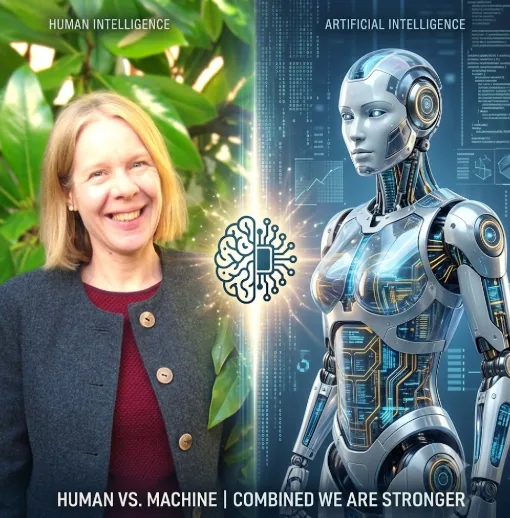
A few weeks ago, I set myself an experiment.
I was preparing for a keynote, speaking to a room of senior female leaders about what it’s really like to spend large parts of a career as the “only woman in the boardroom” — the highs, the exhausting lows, and what I wish someone had told me on day one.
Since I started my own executive coaching practice, I’ve been curious about the rise of AI coaching. So, I decided to test it. I took this same keynote challenge and worked through it twice: once with an AI, and once with a veteran human coach who knew nothing about me beyond what I said in the room.
Now, to be clear from the outset: this was a sample size of one. It is highly subjective, and it’s certainly not empirical research. It is simply my personal experience navigating one very loaded topic. But the contrast between the two sessions was so stark that it strongly influenced how I view the future of leadership and colleague development.
Same brief. Same goal. Two completely different experiences. Here is what actually happened — and why I now believe the question isn’t “AI or human,” but knowing exactly which one to reach for.
The AI Session: Sharp, Fast, and a Little Hollow
The AI started with a refreshing dose of honesty. It admitted it had no stage nerves, no real-world experience, and had never stood in front of an audience. But, it had endless presentation frameworks and coaching methodologies it could deploy.
Honestly? It was genuinely useful. Because I like to write to think, typing out my answers suited me. The questions it fired back were sharp and logically structured.
But a few things felt off.
First, the “silence.” After every answer, there was a tiny pause while the system generated a response. It didn’t feel like the safe, held silence of a coaching room. It felt like a robotic hush — a system calculating its next move.
Second, it couldn’t handle discomfort. Even though I told it to act as a critical friend, it frequently managed my ego. If I typed something expressing genuine uncertainty, the AI would briefly acknowledge it and immediately pivot to relentless, upbeat reassurance. It never let me just sit in the messiness of the problem.
By the end of the session, I had a solid structure and some good lines for my speech. It was highly competent. But I hadn’t learned a single new thing about myself, or why this particular topic felt so heavy to me. It answered the brief perfectly, but it completely missed the person behind it.
The Human Session: Messy, Slow, and Transformative
The human session started entirely differently. If I’m honest, it felt much less efficient.
It took us a few minutes just to settle. But once we did, the room shifted. My coach didn’t offer advice, he didn’t steer, and he didn’t give me a neat framework. Instead, he asked questions that were quietly, almost eerily, well-aimed. He just seemed to know exactly where my doubts were hiding — and he went looking for them.
He let me wander off-topic. And every single time I did, those detours produced the most valuable insights of the session.
By the end of our time, I wasn’t just ready to write the speech. I knew exactly how I wanted to show up on that stage. More importantly, I realised that the speech wasn’t actually about me proving anything — it was entirely about serving the audience. That single reframe changed the entire keynote. It wasn’t a tidy bullet point I could hand to a slide designer; it was a fundamental shift in perspective.
The Verdict: Intelligence vs. Meaning
When I sat down to process why these two sessions felt worlds apart, it actually mirrored a lot of the current debate happening in the coaching industry.
For instance, Trayton Vance at Coaching Focus makes a great point: AI is a genuine game-changer for the data side of leadership. It can spot patterns, personalise learning paths, and flag burnout risks before they surface. But he argues that the relational core of coaching — the trust, the empathy, reading what isn’t being said — stays firmly human.
Dr. Tatiana Bachkirova takes this a step further. She points out that human intelligence relies heavily on our physical and emotional embeddedness in the world; our emotions are central to our thinking and action. When we sit with a client, we are dealing with meaning and subjectivity, co-constructing an understanding in real-time. AI simply lacks this capability, offering only a surrogate of responsive understanding and “pretend empathy.”
In fact, Bachkirova argues that calling an algorithm a “coach” is misleading — she suggests “digitally assisted self-coaching” is a far more accurate description. AI solves problems differently than humans do, bypassing the hard questions of meaning, relevance, and true insight.
This perfectly matched my own unscientific experiment.
So, Where Does Each Win?
Use AI for logic. If you need to structure an argument, prepare for a specific meeting, or get some judgment-free thinking space at 11 PM, use AI. It is fast, available, and excellent at organising your thoughts.
Use a human for meaning. If you are trying to figure out why you keep shrinking yourself in rooms full of senior individuals, or how to rebuild your confidence after a brutal setback, you need a human. Those aren’t logic problems. They are identity problems. And meaning only gets built between two people — in the pauses, the tangents, and the moments where someone hears exactly what you aren’t saying.
Going forward, this is how I’m operating. AI absolutely has a seat at the table to get the first draft moving. But it’s not the same seat as the person sitting across from you, fully and humanly present. If you want a fuller picture of what that human seat actually delivers, the real impact of executive coaching for middle and senior leaders is worth reading.
Some things you really can work out with a well-trained chatbot. But some things only shift when there’s another human being in the room who has nothing to prove and nowhere else to be.
Your Next Step
If you are a senior leader navigating high-stakes visibility, complex transitions, or the quiet identity questions that sit underneath your career, let’s talk.
Book a discovery call and let’s figure out what kind of support you actually need right now.
Ute Thomas is a former Regional Director at Lidl and ILM Level 7 certified executive coach. She works with senior leaders on the challenges that logic alone can’t solve.